Erosion in underground pipe systems can be caused by aging, damage, overloading, misuse, poor management, and neglect. If the wastewater system is damaged, infiltration (liquid movement inward) occurs. The system’s capacity and treatment capability decrease, hydraulic load increases, and naturally, costs for operations and maintenance rise. The evaluation and inspection techniques for infrastructure systems are varied, with their own advantages and obstacles.
| Method | Application | Advantages | Disadvantages |
|---|---|---|---|
| Mobile CCTV (Closed Circuit Television) | Robot-assisted examination of pipe wall surfaces | 1. Most commonly used technique 2. Not overly expensive compared to others | 1. Requires significant effort in data interpretation 2. May miss damages underwater or behind obstacles |
| Fixed CCTV | Inspection of selected pipes’ walls for mobile CCTV assessments | 1. Cheaper than mobile CCTV 2. Used as an imaging technique for other methods | 1. Application limited on lines near chimney edges 2. Requires significant effort to interpret data 3. May miss damages underwater or behind obstacles |
| Ground Penetrating Radar (GPR), Electromagnetic System | Detecting water and void formation in surrounding soil and delamination of pipe walls | 1. Can be applied from the pipe surface or internally (no need for pipe entry) 2. Can detect deep damages | 1. Developing field. Needs field tests to advance the technique 2. Difficult data interpretation 3. More expensive than CCTV |
| Laser Scanning | Examination of pipe wall surface | 1. Provides accurate geometric measurements. 2.Supports computer-aided analysis and data storage. | 1.Still in the development stage, and commercially available for large pipes only. 2.More expensive than CCTV. 3.Works only on water pipelines. |
| Ultrasonic | Examination of pipe wall surfaces and deformation levels | 1. Measures damages above and below the waterline 2. Computer-assisted analysis 3. Digital storage | 1. Hard to identify fractures 2. Requires cleaning for accuracy 3. More expensive than CCTV |
| Light Line CCTV | Measuring only damage | Accurate assessment of pipe damages | More expensive than CCTV |
| Vibration Method | Measurement of pipe wall and bedding conditions | 1. Can assess individual pipe sections or the entire pipe | 1. In development stage 2. Can only be applied for limited damage types |
| Infrared Thermography | Detection of voids and leaks | 1. High production rate 2. Usable during both day and night | 1. Requires experience to interpret thermograms 2. Expensive |
| Sewer Scanner and Evaluation Technology (SSET) | Examination of pipe wall surfaces | 1. Measures pipe degradation 2. Can expand scanned images environmentally 3. Stores images digitally | 1. More expensive than CCTV |
| Impulse Echo & SASW | Measurement of pipe wall integrity and surrounding soil conditions | 1. Detects damage behind pipes | 1. Only applicable for large diameter pipes 2. Cannot detect specific damage locations 3. More expensive than CCTV 4. Results are linked to pipe wall and bedding behavior |
Rehabilitation of an infrastructure system is performed after collecting the following data:
Infiltration (inward leakage) and exfiltration (outward leakage) are the two main issues that lead to increased pumping and treatment loads. The second major problem is the collapse of sewers. When groundwater leaks into a pipe through cracks, it increases the gap between the pipe and the surrounding soil. This weakened soil causes the ground above the pipe to collapse. Increased hydraulic capacity causes greater exfiltration and worsens the problem.
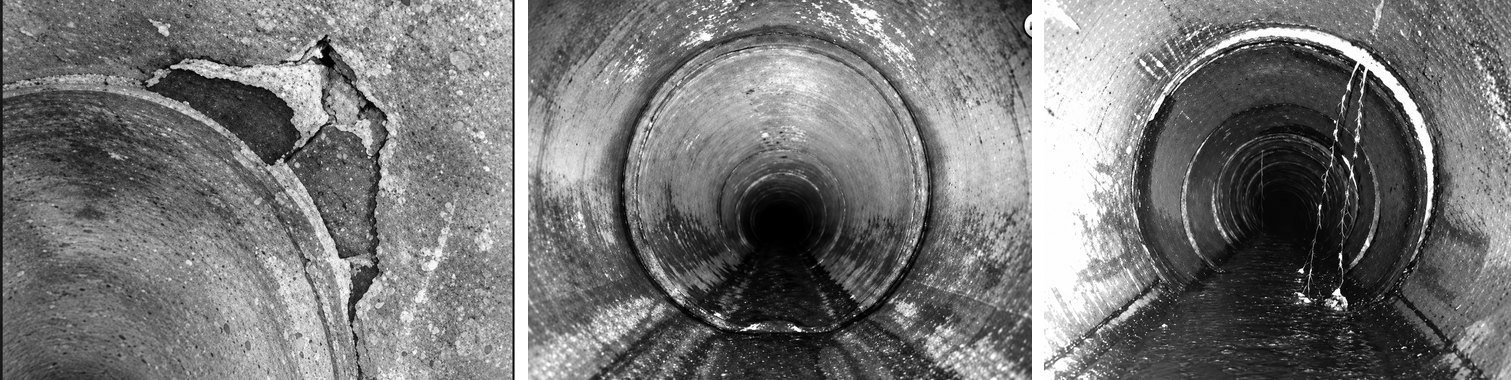
Figure: Structural Failures – Pipe cracks, misalignment at joints, and leakage (from left to right).
The Turkish Society for Infrastructure and Trenchless Technologies is committed to advancing construction methods and infrastructure systems. Through national and international collaboration, the association seeks to provide optimal solutions to manufacturers, users, and researchers alike.